Third Language, Grade 6
The short version
All Std. 6 students studied Sanskrit in Unit 1.
They will continue with Sanskrit during Unit 2.
After the Unit 2 examinations, the teachers will review each student's performance.
The teachers will recommend whether the student should:
- continue with Sanskrit, or
- drop Sanskrit and move to Hindi from Unit 3.
The final decision will be taken by the parents.
No decision has to be taken now.
Why is this decision required?
CBSE has changed its third-language policy more than once.
Based on the latest information, students who are in Std. 6 during 2026–27 are expected to appear for a Board examination in the third language when they reach Std. 10.
Walnut is an English-medium school.
Therefore:
- English will be the first language.
- Marathi will be one of the two other Indian languages, as it is compulsory under the State Government's language policy.
- The third Indian language can be Sanskrit or Hindi.
The two possible combinations are:
- English, Marathi and Sanskrit
- English, Marathi and Hindi
We must choose the combination that is most suitable for each student.
What will happen during Unit 2?
There will be no change during Unit 2. All students will continue with Sanskrit.
The Unit 2 examinations will also be conducted as planned.
This information is being shared now only so that parents know what will happen later.
Why are all students studying Sanskrit for two units?
The first two units give the teachers enough time to see:
- whether the student understands Sanskrit
- whether the student can learn the grammar
- whether the student remembers the vocabulary
- whether the student practises regularly
- whether the student can manage Sanskrit with the other subjects
The teachers will review the students after the Unit 2 examinations.
Will the recommendation to drop be based only on Sanskrit marks?
No. Sanskrit marks will be considered, but they will not be the only factor.
The teachers will look at the student's overall academic performance.
This is important because the workload for all subjects increases substantially in the higher standards.
There is a clear jump from Std. 5 to Std. 6.
There is another large jump from Std. 8 to Std. 9.
The teachers will consider how the student is managing all subjects.
Why will performance in other subjects be considered?
Mathematics becomes increasingly difficult every year from Std. 6 onwards. It demands a large amount of time at home for focused practice and revision.
Science also becomes much more detailed in the higher standards. This is especially noticeable from Std. 8 to Std. 9. Students have to understand, remember and process more information. There are also a lot of numerical problems in the higher standards.
Social Studies has a large amount of content. Students have to read regularly, remember many details and practise writing long answers.
English performance will also be taken into account as the level of writing expected increases in the higher standards.
So, for students whose study time is already fully taken up by these subjects, adding Sanskrit, which requires a lot of practice and memorisation, leaves too little time for each subject.
How will the teachers make the recommendation?
The teachers will consider performance in all subjects, learning ability, regularity in classwork and homework, ability to work independently, the amount of help the student needs and whether the student is already struggling with the total workload. The recommendation will be based on the student's overall academic position.
How should parents think about the two languages?
The choice is not between an easy language and a difficult one. Both languages require regular work. The real question is how a student's available study time is best divided across all the subjects.
Sanskrit rewards students who have time left over after Mathematics, Science, Social Studies and English are under control. For such students it can add significantly to the total score.
Hindi has a more extensive syllabus and higher writing expectations, which makes it harder to score very high marks in. It is not, however, difficult to pass. Students already have basic familiarity with Hindi from their environment, so the time needed to reach a comfortable passing level is far less than for Sanskrit, where every word and every rule must be learnt from the beginning.
When may Sanskrit be recommended?
Sanskrit may be recommended when a student is following the language comfortably and is also managing the other subjects without difficulty. Such a student has the time and the study habit to do justice to Sanskrit, and stands to gain from it in the Board examination.
When may Hindi be recommended?
Hindi may be recommended when a student's study time is already fully occupied by the other subjects. In such cases, continuing with Sanskrit means taking time away from Mathematics, Science, Social Studies and English — subjects that demand sustained practice and revision through the higher standards. For such students, Hindi may require less study time to reach a passing level, allowing them to spend more time where it is needed.
What happens after the Unit 2 examinations?
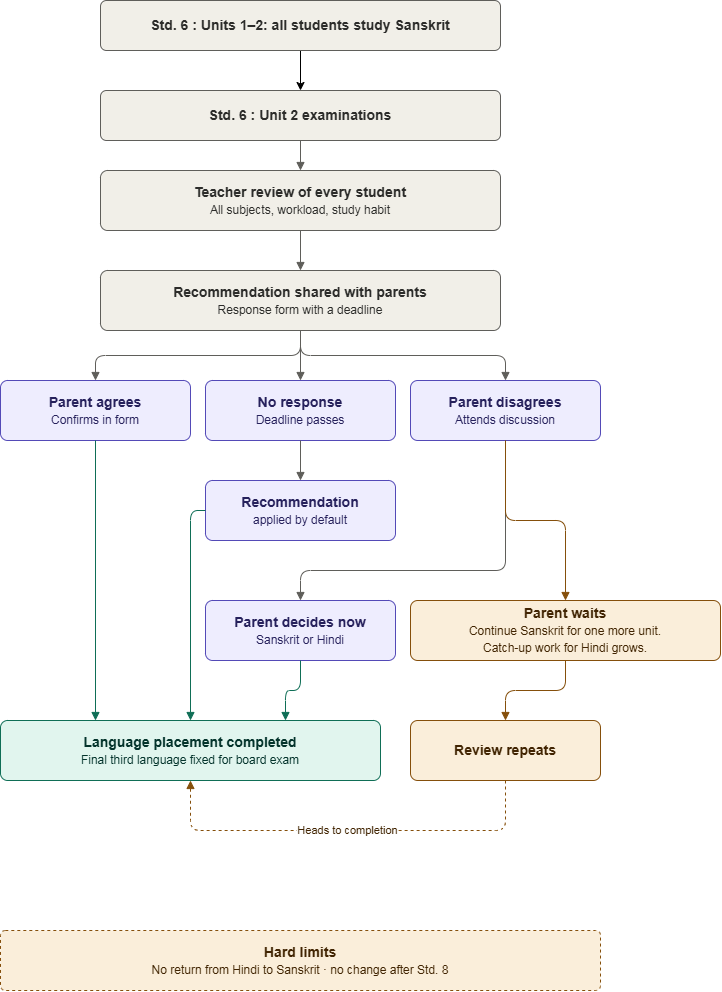
The teachers will review every student and recommend Sanskrit or Hindi. This recommendation will be shared with the parents.
- If the parent agrees with the recommendation, they should indicate this in the form that will be shared at that time.
- If the parent disagrees with the recommendation, they should indicate this in the form and attend the discussion at the time mentioned.
- If no response is received by the deadline mentioned at that time, the student will be placed in the language recommended by the teachers.
- After that, the differential language groups will be rearranged. Students moving to Hindi will begin Hindi from Unit 3.
Who takes the final decision?
The teachers will give a recommendation, but parents who respond by the deadline will take the final decision. Parents should discuss the recommendation with an open mind before taking the final decision.
There are two possible disagreements that parents may have after receiving the recommendation:
Option A : Teachers recommend Sanskrit, but parents want Hindi
The teachers may feel that a student can manage Sanskrit well and may score well in it. The parents may still choose Hindi. However, the student may then lose a good scoring opportunity. Parents should understand the reason for the recommendation before deciding.
Option B : Teachers recommend Hindi, but parents want Sanskrit
The teachers may recommend Hindi because they feel that Sanskrit is adding too much pressure. Parents may still decide that the student should continue with Sanskrit. However, if the student eventually moves to Hindi at a later stage, there will be a large amount of missed Hindi work to cover (which they will have to do on their own) in addition to regular studies. Parents who are considering Hindi at all should decide now rather than later.
Why should the decision to drop Sanskrit not be delayed?
A student studying Sanskrit will not attend Hindi classes. We are not making students study four languages. Therefore, a student who continues with Sanskrit will miss the Hindi work being taught. The longer the student waits before moving to Hindi, the more work the student will have to cover later, including grammar, reading, descriptive writing, creative writing and comprehension. It is better to take the decision sooner if it already appears likely that the student will move to Hindi. A change of third language will not be permitted after Std. 8 as each student's subject choices are already recorded with the Board by then.
Students moving to Hindi in Unit 3 will not have to catch up as the Hindi course will begin at that time. The later the student moves, the more Hindi work the student will have to cover. Parents should not assume that changing much later will be simple. It will add a lot of extra work to the student's regular studies.
Can a student move from Hindi back to Sanskrit?
No. Sanskrit is taught from the beginning of Std. 6 and every unit builds on the previous one. A student who has not studied Sanskrit from the start cannot join the course later.
What if the parent insists on Sanskrit and the student continues struggling with Sanskrit?
Sanskrit is a regular school subject. The student must pass the subject. If a student continues with Sanskrit but keeps struggling, this may affect the student's result and promotion.
For example, a student who fails Sanskrit (or any subject) in Std. 8 will not be promoted to Std. 9 under the school's promotion rules. The same applies in promotion from Std. 9 to Std. 10.
This is why the teacher's recommendation should be considered carefully. The recommendation is meant to reduce unnecessary pressure and give the student the best chance of doing well.
Here is a friendly image to help you visualise the process: